


Direct visual inspection
Useful for atmospheric discharge points. It requires experience to distinguish live steam from flash steam.
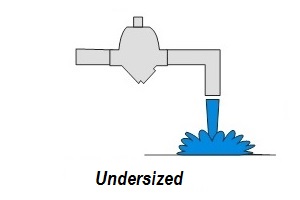
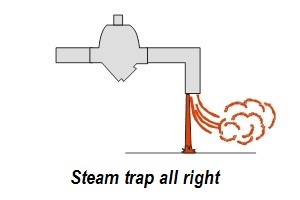
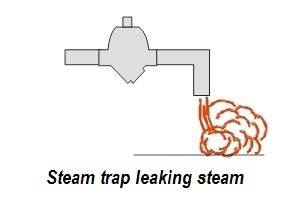
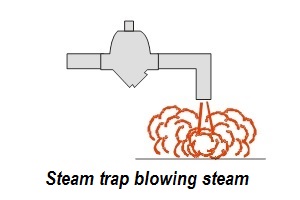
Technical diagnostics to detect live steam leaks, blockages, efficiency losses, and operational issues in trap stations.
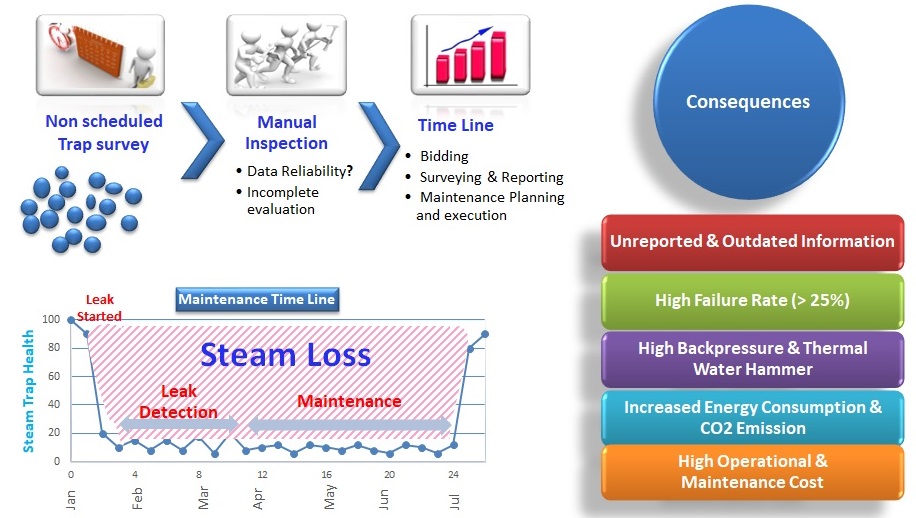
The objective is to identify steam leaks, low energy efficiency, flooding, blockages, high backpressure, inadequate discharge temperatures, water hammer, and design or sizing problems.
In industrial operation, more than 15% of steam traps can leak live steam if there is no effective inspection and maintenance program.
This steam leak rate is reduced to values in the range of 7% to 8% by applying an effective inspection and maintenance program.
A technical plan for predictive, preventive, and corrective inspection based on the use of intelligent steam traps (monitored bithermostatic traps) makes it possible to apply the Intensive Maintenance methodology, which reduces the steam leak rate to values below 1% and improves the overall efficiency of the steam and condensate network.
Reference values for trap stations based on inspection and maintenance periodicity.
| Inspection frequency | Failure rate (%) |
|---|---|
| 24 months | 30 |
| 18 months | 25 |
| 12 months | 15 |
| 6 months | 7 |
| 3 months | 5 |
| 1 month | 3 |
| Continuous monitoring | <0.2 |
Verification should assess condition, suitability, and efficiency of all station components (trap, isolation valves, bypass, and return line). In practice, the best results come from combining methods.
Useful for atmospheric discharge points. It requires experience to distinguish live steam from flash steam.
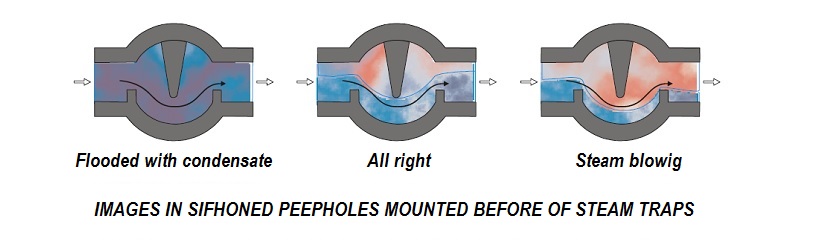
A siphonic sight glass installed upstream helps distinguish condensate from live steam more clearly.
Fast and reliable method for internal steam/gas leaks. It requires proper sensitivity setup and technical criteria.
Support method for cyclic traps. It should be combined with other methods to avoid diagnostic errors.
In atmospheric discharge, flash steam may be confused with real leaks. Diagnosis must consider pressure and condensate load.
On cyclic/continuous discharge traps, changing backpressure during testing can alter real trap behavior.
Limited to low-pressure applications. Glass fouling from oxides reduces visibility and increases maintenance cost.
Without trap type, service data, and differential pressure, temperature alone may lead to incorrect conclusions.
Adjust scale according to steam pressure and trap type.
Apply contact probe firmly and record baseline reading.
Take readings 1-2 m downstream to distinguish live steam leaks from flash steam.
With dP < 1 bar reliability drops; use combined methods and expert criteria.
The most robust method because it tracks ultrasonic, temperature, and backpressure trends over time. Unlike spot inspection, trending enables early anomaly detection before failure.